


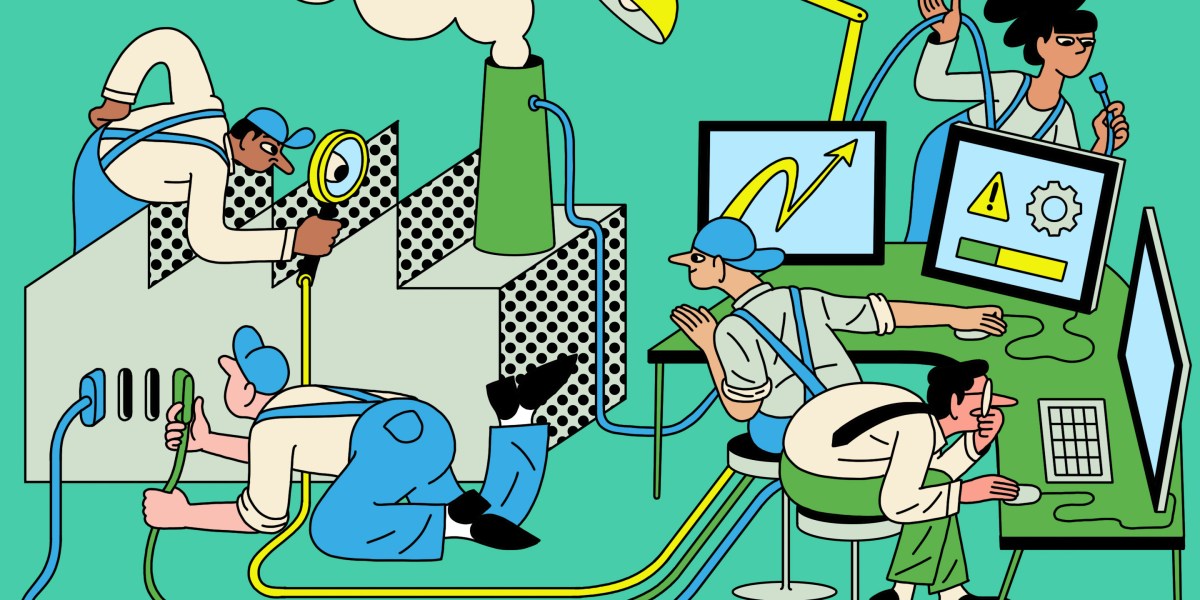

There are an estimated 180 million utility poles at the moment in operation within the U.S., and on occasion, they should be inspected. Traditionally, crews of specialised employees would go from pole to pole, climbing to the highest and evaluating the integrity of the construction, no matter whether or not or not the pole had a recognized drawback. At this time with AI, sensors, and drones, groups can detect the state of this important infrastructure with out bodily being there, sending a employee on website solely when there’s a difficulty that must be addressed. What’s extra, the info made doable by these distant monitoring programs means employees are extra knowledgeable and ready for the job when they’re deployed to a pole.
“There’s lots of diagnostic time to determine what’s occurring, however now think about that you simply simply present up on a website with the knowledge. So that you’re sending any person to the appropriate spot when there’s an precise situation, after which they’re more likely to have the appropriate half, or the appropriate truck, or the appropriate supplies they want in that second,” stated Alex Hawkinson, CEO of BrightAI, an organization utilizing AI options to deal with employee challenges within the power sector and different blue-collar industries together with HVAC, water pipeline, development, manufacturing, pest management, and subject service.
It’s only one instance of how AI-enabled applied sciences are more and more serving to employees in blue-collar industries do their jobs, saving them time and power, and decreasing their publicity to dangerous conditions (like having to climb to the highest of utility poles). The brand new wave of AI can be permitting employees throughout these fields to get extra out of the applied sciences they’ve already been utilizing and knowledge they’ve been gathering. AI’s long-term impression on jobs is an more and more necessary subject of debate, as analysts and economists search for clues by inspecting hiring practices at totally different corporations. However in lots of of those blue-collar fields which might be at the moment fighting labor shortages, AI is a welcome helper.
Labor shortages drive blue-collar urge for food for automation
Blue-collar industries that require specialised commerce abilities are a few of the most labor-squeezed components of the workforce, significantly as growing older employees who have been skilled for them years in the past begin to retire. Between 30% and 50% of water pipeline employees are anticipated to retire within the subsequent decade, for instance, and there aren’t sufficient youthful employees coming into the sector to exchange them. It’s an analogous scenario in farming: The typical age of the U.S. farmer is 58.1 years outdated, and there are 4 instances as many farmers who’re 65 or older than these youthful than 35, in response to the 2022 U.S. Census of Agriculture. Farming additionally has to take care of the seasonality of its labor wants, which sway dramatically all year long.
“One other huge false impression is that autonomy is about labor alternative,” stated Willy Pell, CEO of John Deere subsidiary Blue River Know-how, relating to AI within the farming business. “In lots of circumstances, it simply isn’t there to start with. So it’s not changing something—it’s giving them labor.”
Whether or not it’s a utility employee inspecting a pole or a farmer harvesting crops, doing extra with much less time is paramount when there aren’t sufficient individuals to get the work completed.
“One of many largest issues is that farmers by no means have sufficient time. After we may give them their time again, it makes their lives meaningfully higher. They get to spend extra time with their household. They get to spend extra time working the higher-leverage components of their enterprise, the higher-value components of their enterprise, and so they have much less stress,” stated Pell. “There’s an unbelievable quantity of hysteria that comes with not understanding for those who can run what you are promoting since you’re counting on a particularly sparse, fragile labor pressure that can assist you do it. And autonomy helps farmers with this drawback.”
Crucially, it’s not simply business leaders who’re on board, however employees too. A study on employees’ openness to automation carried out by Massachusetts Institute of Know-how researchers (and backed by Amazon) discovered that these with out school levels, or “blue-collar” employees, are extra open to automation than these with levels. In response to the research, 27.4% of employees with no school diploma stated they consider that AI can be useful for his or her job safety, in comparison with 23.7% of employees with a school diploma.
AI supercharges the info and applied sciences employees are already counting on
For a lot of blue-collar employees, the issues they’re going through on the job are more and more measurable. For instance, Blue River Know-how has neural networks that combine immediately into field-spraying machines, detecting the crops and weeds in an effort to spray herbicides solely on the weeds. Applied sciences like sensors and drones have been round for years, however current progress in AI is permitting them to derive extra profit from these applied sciences and the info they produce.
“A number of factories and different industrial environments have had knowledge round for a very long time and haven’t essentially recognized what to do with it. Now there are new algorithms and new software program that’s permitting these corporations to be much more clever with utilizing that knowledge to make work higher,” stated Ben Armstrong, coauthor of the research on employee attitudes surrounding automation and an MIT researcher who focuses on the connection between know-how and work, particularly in American manufacturing.
BrightAI’s Hawkinson echoes this, saying that “a easy sensor studying isn’t sufficient to provide the sample that you simply care about” and that it’s the maturation of AI that’s made the distinction. For instance, the corporate has tapped giant language fashions (LLMs) for voice interplay to permit employees to work together with sensor knowledge by way of wearable units, which is essential for employees who must have their fingers free, as is frequent within the fields BrightAI operates in. Hawkinson stated that corporations working with BrightAI’s platform are seeing productiveness lifts between 20% and 30% inside three to 6 months of getting up and working.
General, lots of the potential advantages hinge on utilizing AI to enhance group and entry to the knowledge that’s important to get these jobs completed. Blue River Know-how, for instance, is tapping LLMs to show the very difficult info round gear error codes right into a extra readable format with easy-to-understand troubleshooting suggestions.
“In lots of the businesses we’re finding out, there are these corporations’ particular instruments that employees can use to resolve issues of their job by both doing a unique sort of analysis or making an attempt to arrange info in a brand new method,” Pell stated. “And I believe for blue-collar employees who’ve lots of data concerning the explicit processes and applied sciences that they work on, that may be actually thrilling.”
Discover extra tales from Fortune AIQ, a brand new sequence chronicling how corporations on the entrance strains of the AI revolution are navigating the know-how’s real-world impression.
