


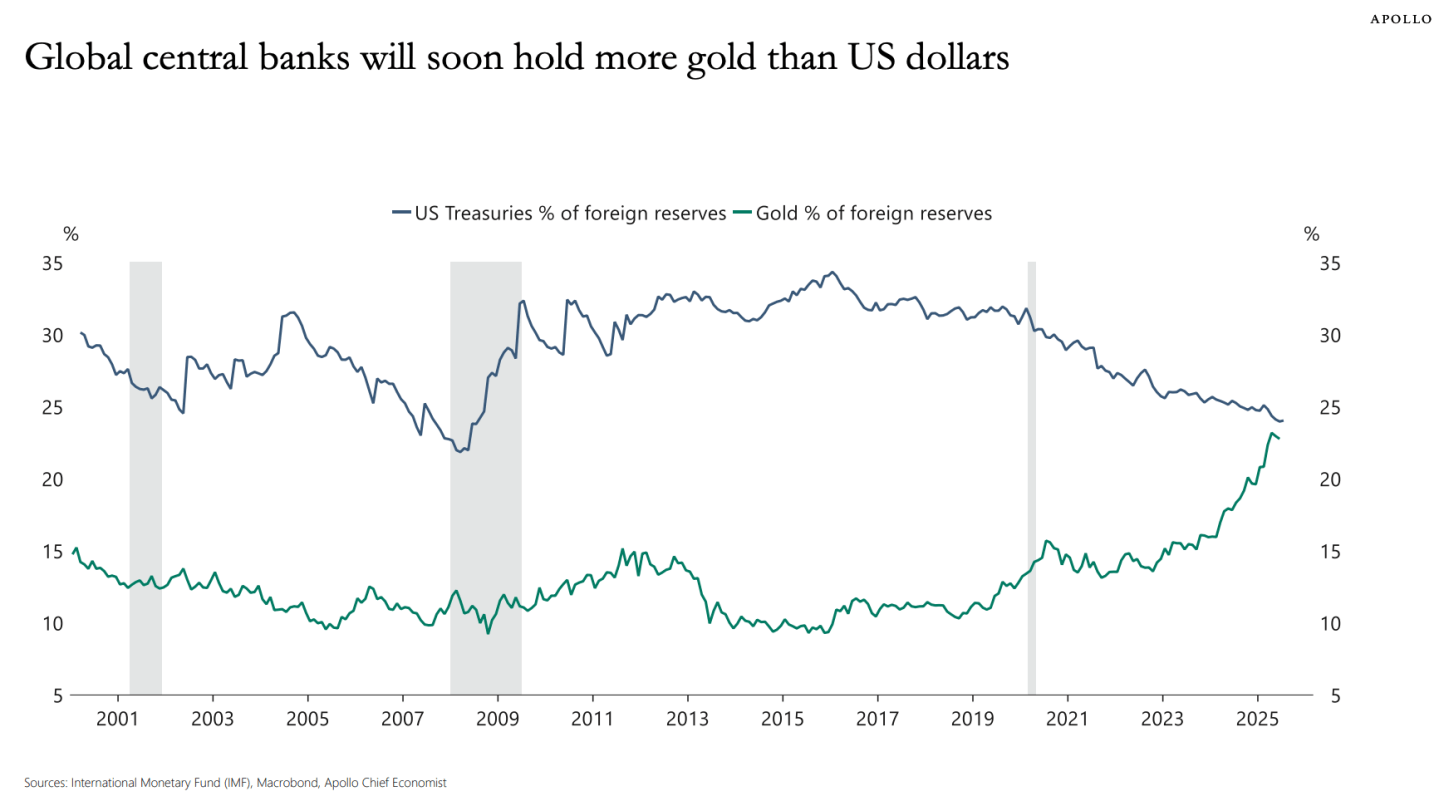
China has emerged as a essential drive propelling gold costs to report highs in 2025, in accordance with some of the influential analysts on Wall Avenue. Torsten Slok, Apollo International Administration’s chief economist who’s famend for his pithy, incisive day by day electronic mail, The Each day Spark, highlighted on Tuesday that China’s impression goes past central financial institution shopping for; it additionally includes arbitrage buying and selling, sturdy family demand, and safe-haven funding conduct, and he produces convincing data backing these claims. In opposition to a backdrop of macroeconomic uncertainty, Slok notes that at this fee, world central banks will quickly maintain extra gold than U.S. {dollars}, the world’s reserve forex.
“China is enjoying a key function within the ongoing rise in gold costs due to central financial institution shopping for, arbitrage buying and selling, and elevated speculative and safe-haven demand amongst Chinese language households,” Slok wrote in his Tuesday Each day Spark, including four charts that show his level. He included a fifth displaying that “increased enterprise uncertainty within the U.S. can also be pushing gold costs up.”
Slok’s feedback got here with the sort of uncanny timing acquainted to market-watchers: on the morning of a sell-off towards a strengthening greenback that marked gold’s biggest slump in 12 years, down as a lot as 6.3% after the day before today’s peak of $4,381.52 an oz.. “It’s throughout corrections {that a} market’s true power is revealed, and this time must be no totally different,” Ole Hansen, commodities strategist at Saxo Financial institution AS, instructed Bloomberg of the sudden cool-off. Gold was down 4.78% to $4,151.20 an oz. at 12:10 pm ET, nonetheless up greater than 55% year-to-date.
Gold’s 50% leap in 2025 marked a seminal second: It crossed the $4,000 an oz. threshold after President Donald Trump enacted a 100% tariff on China, severely disrupting world commerce and eroding confidence within the dollar. Because the greenback depreciates and U.S. shares hunch, gold shines brighter as a protected asset. Veteran analyst Ed Yardeni forecasts a worth of $5,000 for 2026 and as a lot as $10,000 by 2028 if present traits persist—citing the “debasement commerce” that favors gold and Bitcoin when fiat currencies danger inflation and systemic instability.
Different reporting provides proof to Slok’s findings. The Individuals’s Bank of China has been a relentless purchaser of gold, marking its eleventh consecutive month-to-month purchase this September, per commodities news site Kitco. China’s formally reported reserves reached 2,264 tonnes by mid-2025, however business consensus means that actual holdings could also be even better owing to underreporting—a tactic usually employed for strategic benefit. This central financial institution shopping for isn’t just a statistical curiosity; it establishes a worth ground that alerts institutional and personal traders to comply with go well with, reinforcing demand cycles.
Beyond official reserves, Chinese consumers are fueling the rally. Gold withdrawals from the Shanghai Gold Exchange surged in September, hitting a month-to-month tally of 118 tonnes, up each month over month and 12 months over 12 months. Chinese language gold ETFs noticed web inflows in September, and gold futures buying and selling volumes have spiked notably—indicating a strong mixture of family safe-haven demand and speculative buying and selling inside China itself. This rising involvement of retail traders magnifies China’s impact on world gold pricing.
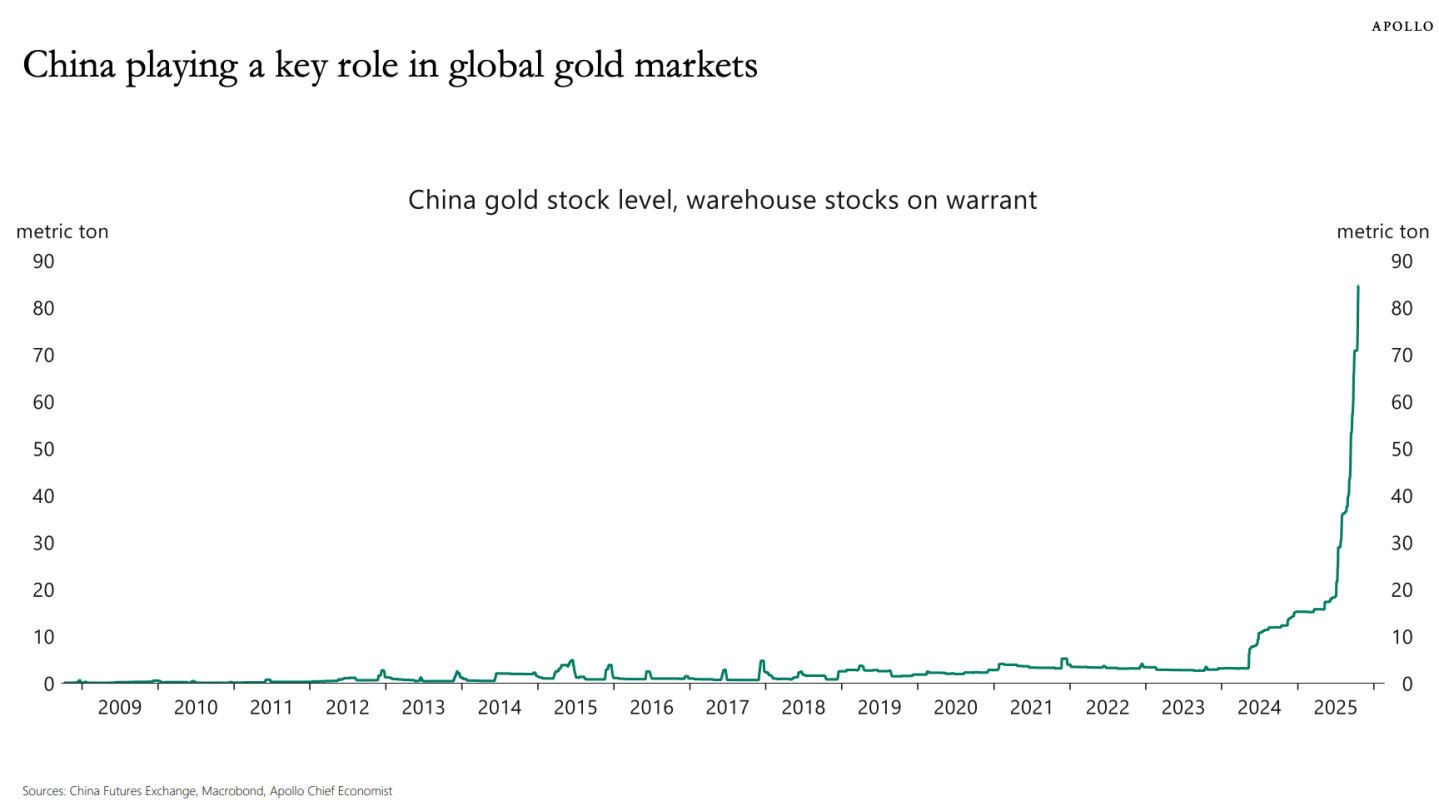
Slok cites the China Financial Futures Exchange in reporting that the gold stock level in China has soared throughout 2025, and Bloomberg data shows that household demand for gold exchange-traded funds (ETFs) is also surging. This indicates that far beyond whatever the People’s Bank of China is doing, Chinese households are driving significant activity, as the China-U.S. trade war rumbles on. Presidents Xi Jinping and Donald Trump are due to meet soon with Xi imposing new restrictions on rare earths access and Trump threatening 100% new tariffs in response—before seeming to back off.
Global ripple effects: U.S. uncertainty and beyond
While Chinese buying is the dominant catalyst, increased business uncertainty in the U.S. has added fuel to the fire. As economic volatility and geopolitical risk rise—exacerbated by U.S.-China trade tensions, dollar depreciation, and interest rate cuts—American investors have joined the move into gold, driving up prices even further. Leading institutions, including Goldman Sachs, have raised forecasts for gold, projecting prices as high as $4,900 per ounce for December 2026, well above current record levels. When analysts combine these factors with Slok’s data, the result is a compelling case: China’s gold moves are the linchpin, but the effect is global.
Slok’s analysis echoes observations from Goldman Sachs commodities strategist Lina Thomas and Canadian businessman and legendary gold investor Pierre Lassonde, who identified earlier this month that at present’s gold rally is grounded in fundamentals, not hype. Thomas emphasised that financial instability—particularly tariff-induced uncertainty and greenback depreciation—has pushed gold up 65% in 2025, reaching a surprising $4,242 per ounce. With the U.S. and China locked in a commerce standoff, each central banks and personal traders are diversifying away from the greenback, additional supercharging gold demand.
Thomas and Lassonde drew explicit parallels to the 1970s, when Nixon’s shock termination of the gold standard and subsequent fiscal turmoil sent gold prices accelerating by over 2,300% across the decade. Lassonde describes the current moment as “the equivalent year 1976 right now of that four-year bull market,” suggesting that the rally could have years left to run.
Even traditional gold skeptics have joined the rush. JPMorgan Chase CEO Jamie Dimon, lengthy unconvinced of gold’s advantage, admitted in conversation with Fortune editor-in-chief Alyson Shontell that “This is among the few occasions in my life it’s semi-rational to have some in your portfolio”—a marked change pushed by the sort of world uncertainty and market breakdown additionally evident in Slok’s evaluation.
Citadel CEO Ken Griffin, the billionaire hedge fund founder, is sounding a notice just like Dimon’s, however he’s not glad about it. “I now view gold as a protected harbor asset in a approach that the greenback was seen. That’s what’s actually regarding to me,” Griffin told Bloomberg earlier this month.
One other hedge fund billionaire, Bridgewater founder Ray Dalio, stated earlier this month that traders should put 15% of their portfolio into gold, calling it “a really wonderful diversifier.” China appears to agree.
[This report has been up to date to incorporate Tuesday buying and selling information on gold’s largest hunch in over a decade
