


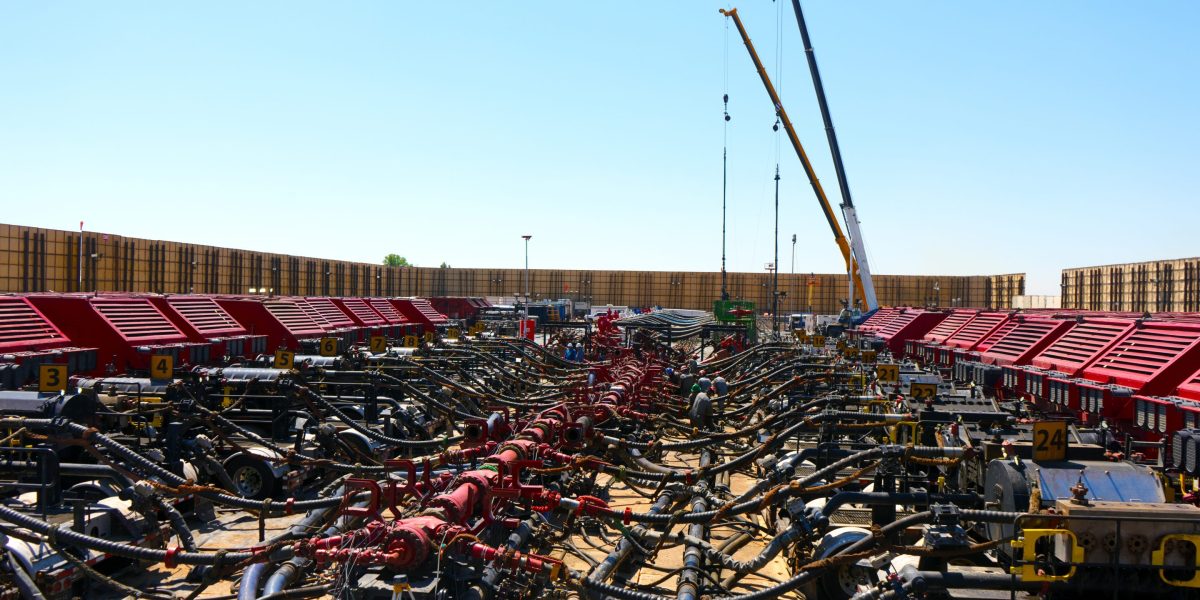
Oil costs are their lowest for the reason that pandemic, revenues are falling, and income are shrinking, however some frackers and oilfield gamers are out of the blue thriving within the inventory market as they put money into energy technology for information facilities and trip the AI wave.
Liberty Power—the fracking firm cofounded by U.S. Power Secretary Chris Wright—noticed its inventory soar 30% after asserting on October 17 it will greater than double its deliberate energy technology capability for information facilities. Halliburton’s inventory is up about 15% this month since revealing its 20% possession stake in VoltaGrid and its plans to associate on powering information facilities worldwide. Different main oilfield gamers resembling Baker Hughes, trade chief SLB, and Solaris Power Infrastructure are investing massive within the information heart energy rush as properly.
“The demand for energy and for AI is like nothing I’ve ever seen when it comes to demand progress,” mentioned Halliburton chairman and CEO Jeff Miller throughout an Oct. 21 earnings name. “We additionally know that, not solely within the U.S., however around the globe [AI] is a very massive alternative set for a similar degree of progress.”
The AI energy push from some drillers and fracking firms comes as they face the double whammy of weak oil costs and years of declining exercise due to elevated effectivity from drilling rigs and hydraulic fracturing, or frac, fleets.
U.S. oil manufacturing is at an all-time excessive of 13.6 million barrels per day—though it’s believed to have plateaued—though the variety of frac fleets required within the U.S. dipped more than 50% in six years as bigger wells had been accomplished extra shortly. For AI, most firms are utilizing on-site pure gasoline generator units or modestly sized gas-fired generators.
Tom Curran, power expertise analyst with Seaport Analysis Companions, advised Fortune the facility alternative is an rising brilliant spot in an trade struggling by way of a hunch.
“It’s very actual, it’s early, and it’s to be decided which kind of approaches and forms of contracts show to be essentially the most aggressive,” Curran mentioned. “Buyers are nonetheless ascending the training curve and attempting to get snug with the risk-reward profiles of this new area of interest that’s arisen.”
Considerably surprisingly, the most important criticism of Liberty CEO Ron Gusek was directed on the boss of his former boss—President Trump—particularly on the metal and aluminum wanted for energy tools.
“The secretary of power (former Liberty CEO Chris Wright) has referred to as the race for AI dominance our subsequent Manhattan Challenge,” Gusek mentioned in his Oct. 17 earnings name. “Successful this race requires entry to huge quantities of latest energy technology capability and related {hardware}, together with many different refined parts. A lot of that is at present made abroad, and far of it’s now topic to tariffs.”
“Is that this a path to profitable a race the administration has recognized as so crucial to our nation’s future? I might argue, no. It’s a path to mediocrity at greatest. I hope we shortly pivot to a distinct course, one which places us firmly on the trail to power and AI dominance right here within the U.S.”
Various approaches to catch the AI bump
Liberty Power already had invested massive in pure gasoline generator tools to impress and energy its fracking providers within the oilfield, and now it’s adapting the digiPower expertise for information facilities. Fortuitously, the timing suits properly with the general trade development of electrifying the oilfield and transitioning away from dirtier diesel energy.
Liberty is growing its energy technology capability from a deliberate 400 megawatts to greater than 1 gigawatt—sufficient to energy about 750,000 houses—by way of 2027. Additional will increase are anticipated to satisfy the rising demand, Gusek mentioned.
“My expectation is we in all probability find yourself with the next share of our capability with information heart prospects than possibly we had anticipated on the outset of our foray into this enterprise,” he mentioned. “We’re assured within the progress trajectory of our energy enterprise and are increasing our energy deliveries in anticipation of buyer conversions from our expansive pipeline of alternatives.”
Liberty and Halliburton—partnered with VoltaGrid—are each leaning on variations of reciprocating pure gasoline generator units lined up one after one other at information facilities. VoltaGrid simply introduced a cope with Oracle to ship 2.3 gigawatts of energy for information facilities.
Whether or not the on-site energy is a brief or long-term answer for hyperscalers, Liberty has a solution. Liberty additionally partnered with nuclear energy startup Oklo for firms to transition to Oklo’s small modular nuclear reactors in 5 years, as soon as they’re prepared to return on-line.
Halliburton, with its bigger international footprint, together with within the oil-dependent and tech-hungry Center East, goals to take its energy partnership worldwide on a “international industrial scale,” as CEO Miller described it on a latest name with analysts.

Different oilfield gamers, resembling Baker Hughes, SLB, and Solaris, are centered on growing gasoline turbine manufacturing for information facilities. Solaris is working with xAI at its Memphis, Tenn., complicated. SLB is rising its “information heart options” enterprise centered on cooling methods and different crucial {hardware}.
The important thing to long-term success, Seaport Analysis’s Curran mentioned, is not only pace however consistency.
“It’s one factor to exit and put collectively the capex and plow it into constructing a fleet of those property and ship them, set them up, and switch them on; it’s one other factor to satisfy the requirements of 24-7 energy reliability,” Curran mentioned.
Gloomier present realities
Whereas the facility alternatives are brilliant, the present earnings reviews are rather more dour because the oil sector slogs together with weakened exercise.
Liberty posted third-quarter web earnings of $43 million, down 42% 12 months on 12 months, whereas quarterly revenues fell 17%.
Likewise, Halliburton’s web earnings plunged all the way down to a barely worthwhile $18 million—together with hefty impairment costs—from $571 million, though revenues solely fell 2%.
“Oil and gasoline trade frac exercise has now fallen beneath ranges required to maintain North American oil manufacturing,” Gusek mentioned. “Oil producers, which comprise a overwhelming majority of North American frac exercise, opted to average completions towards the backdrop of macroeconomic uncertainty and after exceeding manufacturing targets through the first half of the 12 months.”
The businesses are reducing their 2026 capex plans, retiring tools, reducing jobs, and doing as a lot belt tightening as they’ll.
There may be rising optimism that the worldwide oil glut—exacerbated by ongoing OPEC manufacturing hikes—will peak within the first half of 2026, permitting for the trade to rebound within the again half of subsequent 12 months, CEOs mentioned.
Curran sees that sentiment as bullish, even when it means a number of extra months of a downturn.
“We’re lastly reaching the tip of what has been this lengthy, exceptional, continued enhance in U.S. oil manufacturing whereas we’ve had an ongoing contraction in U.S. oilfield exercise,” Curran mentioned. “That’s been due to this actually miraculous continued upturn in productiveness. Properly, that lastly appears to be reaching its finish. Which means, even when they wish to maintain oil manufacturing flat, they’re going to have to begin choosing up exercise subsequent 12 months.”
