


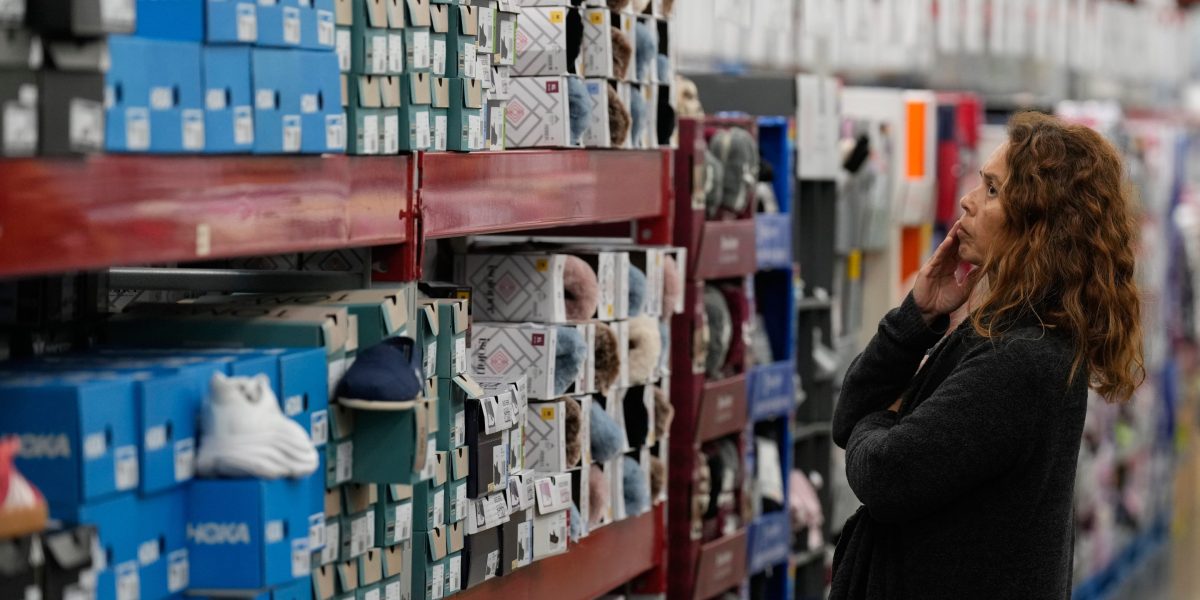

Inflation has risen in three of the final 4 months and is barely larger than it was a 12 months in the past, when it helped sink then-Vice President Kamala Harris’ presidential marketing campaign. But you wouldn’t realize it from listening to President Donald Trump and even among the inflation fighters on the Federal Reserve.
Trump advised the United Nations Basic Meeting late final month: “Grocery costs are down, mortgage charges are down, and inflation has been defeated.”
And at a high-profile speech in August, simply earlier than the Fed minimize its key rate of interest for the first time this year, Federal Reserve Chair Jerome Powell mentioned: “Inflation, although nonetheless considerably elevated, has come down an important deal from its post-pandemic highs. Upside dangers to inflation have diminished.”
But dismissing and even downplaying inflation whereas it’s nonetheless above the Fed’s goal of two% poses massive dangers for the White Home and the Federal Reserve. For the Trump administration, it may discover itself on the unsuitable facet of a potent concern: Surveys present that many People nonetheless see excessive costs as a significant burden on their funds.
The Fed could also be taking a good larger gamble: It has minimize its key rate of interest on the belief that the Trump administration’s tariffs will solely trigger a short lived bump up in inflation. If that seems to be unsuitable — if inflation will get worse or stays elevated for longer than anticipated — the Fed’s inflation-fighting credibility may take a success.
That credibility performs a crucial role within the Fed’s means to maintain costs steady. If People are assured that the central financial institution can hold inflation in verify, they received’t take steps — resembling demanding sharply larger pay when costs rise — that may launch an inflationary spiral. Firms usually improve costs additional to offset larger labor prices.
However Karen Dynan, a senior fellow on the Peterson Institute for Worldwide Economics, mentioned this week that with recollections of pandemic-era inflation nonetheless recent and tariffs pushing up the price of imported items, shoppers and companies may begin to lose confidence that inflation will keep low.
“If that proves to be the case, in hindsight it is going to be that the Fed cuts — and I do count on a number of extra — are going to be seen as a mistake,” Dynan mentioned.
To this point, the Trump administration’s tariffs haven’t lifted inflation as a lot as as many economists anticipated earlier this 12 months. And it stays far beneath its 9.1% peak three years in the past. Nonetheless, shopper costs elevated 2.9% in August from a 12 months earlier, up from 2.6% on the similar time final 12 months and above the Fed’s 2% goal.
The federal government is scheduled to launch the September inflation report on Wednesday, however the information will most likely be delayed by the government shutdown.
Tariffs have pushed up the price of many imported gadgets, together with furnishings, home equipment, and toys. General, the price of long-lasting manufactured items rose almost 2% in August from a 12 months earlier. It was a modest achieve, however comes after almost three many years when the price of such gadgets mostly fell.
The price of some on a regular basis items are nonetheless rising extra rapidly than earlier than the pandemic: Grocery costs moved up 2.7% in August from a 12 months in the past, the most important achieve, exterior the pandemic, since 2015. Espresso prices have soared almost 21% prior to now 12 months, partly as a result of Trump has slapped 50% import taxes on Brazil, a number one espresso exporter, and likewise as a result of local weather change-induced droughts have minimize into espresso bean harvests.
Most Fed officers are nonetheless involved that inflation is just too excessive, in accordance the minutes of its Sept. 16-17 assembly. But they nonetheless selected to chop their key rate of interest, as a result of they have been extra nervous in regards to the danger of worsening unemployment than about larger inflation.
However the concern for some economists is that the continuing rollout of tariffs and the truth that many firms are nonetheless implementing value hikes in response may end in greater than only a short-term enhance to inflation.
“It’s a massive gamble after what we’ve been going by … to depend on it being transitory,” mentioned Jason Furman, an economist at Harvard College and a former prime adviser to President Barack Obama. “As soon as upon a time, (3% inflation) would have been thought of actually excessive.”
Simply two weeks in the past, Trump slapped new tariffs on a range of products, together with 100% on prescription drugs, 50% on kitchen cupboards and toilet vanities, and 25% on heavy vans. On Friday, he threatened “a massive increase of tariffs” on imports from China in response to that nation’s restrictions on uncommon earth exports.
Some firms are nonetheless elevating costs to offset the tariff prices. Duties on metal and aluminum imports have pushed up the price of the cans utilized by Campbell Soups, main the corporate’s CEO to say in September that it’ll implement “surgical pricing initiatives.”
Chris Butler, CEO of Nationwide Tree Firm, the nation’s largest synthetic Christmas tree vendor, says his firm will elevate costs by about 10% this vacation season on its bushes, wreaths, and garlands to offset tariff prices. About 45% of its bushes are made in China, with the remaining from Southeast Asia, Mexico, and different nations. The price of labor and actual property is just too excessive to make them in america, he mentioned.
Butler additionally expects there shall be a diminished provide of synthetic bushes and decorations this 12 months, which may raise industry-wide costs additional, as a result of most manufacturing in China shut down when tariffs on that nation hit 145% earlier this 12 months. Manufacturing resumed after Trump diminished the duties to 30% however at a slower tempo.
Butler has pushed his suppliers to soak up among the value of the tariffs, however they received’t pay all of it.
“On the finish of the day, we will’t take up the whole thing of it and our factories can’t take up the whole thing of it,” he mentioned. “So we’ve needed to move alongside among the will increase to shoppers.”
Many Fed policymakers are conscious of the dangers. Jeffrey Schmid, president of the Federal Reserve Financial institution of Kansas Metropolis, who votes on rate of interest selections, mentioned Monday that prime inflation that outcomes from a lack of confidence within the central financial institution is more durable to struggle than different value spikes, resembling people who outcome from provide disruptions.
“The Fed should preserve its credibility on inflation,” Schmid mentioned. “Historical past has proven that whereas all inflations are universally disliked, not all inflations are equally pricey to struggle.”
But some Fed officers say that different traits are offsetting the influence of tariffs. Fed governor Stephen Miran, whom Trump appointed simply earlier than the central financial institution’s September assembly, mentioned Tuesday {that a} regular slowdown in rental prices ought to cut back underlying inflation within the coming months. And the sharp drop in immigration because of the administration’s clampdown will cut back demand, he mentioned, cooling inflation pressures.
“I’m extra sanguine in regards to the inflation outlook than quite a lot of different individuals are,” he mentioned.
